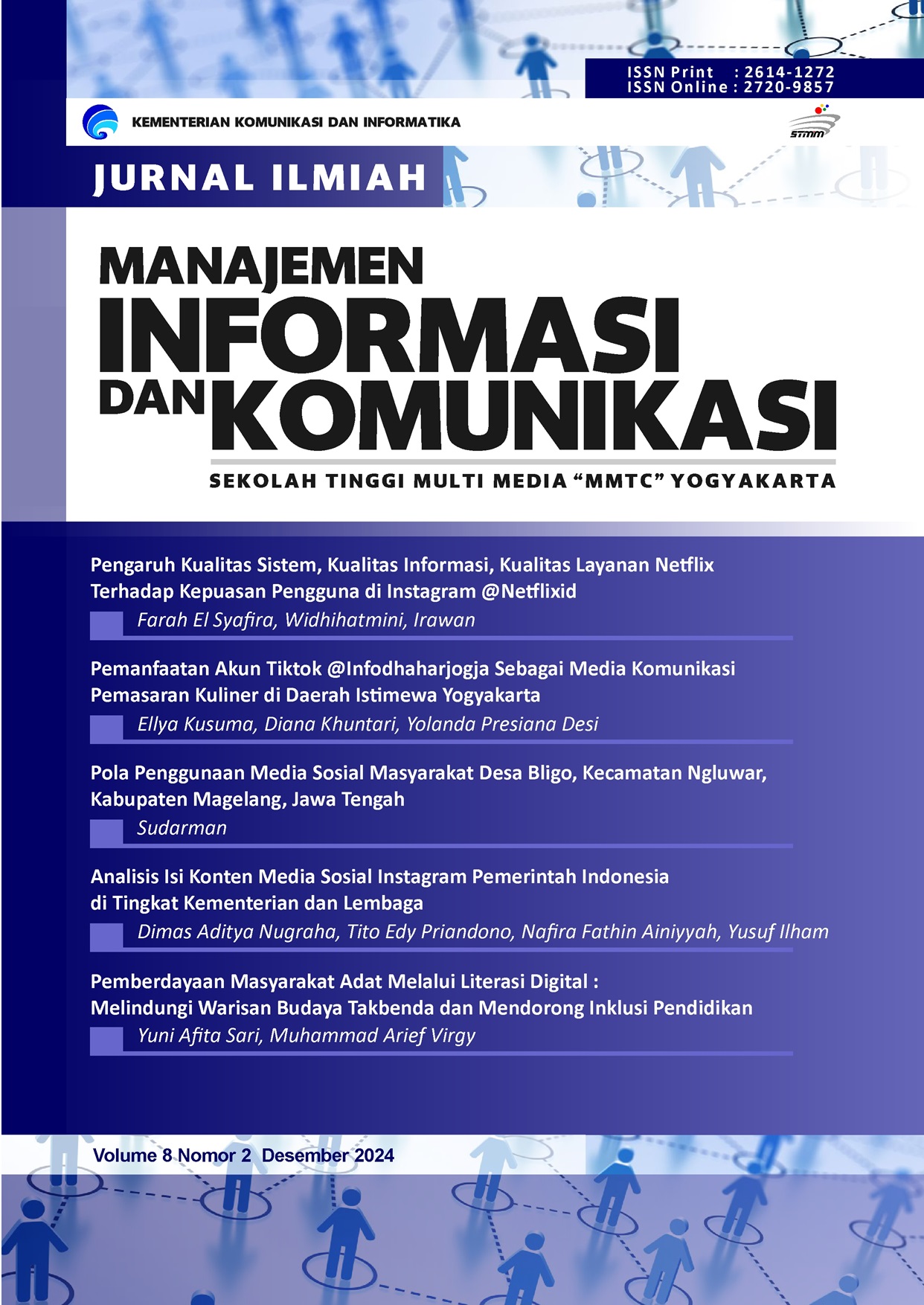
Analisis Isi Konten Media Sosial Instagram Pemerintah Indonesia di Tingkat Kementerian dan Lembaga
DOI:
https://doi.org/10.56873/jimik.v8i2.473Keywords:
Government Social Media, Instagram, Content, Message ContentAbstract
Government institutions need social media channels as a public communication tool to disseminate policies, programs and public information. The government needs to use social media channels to reach a wider community amidst the low level of public trust in government communications and information channels. The aim of the research is to analyze the substance of the content, namely the type and nature of the content, what the audience needs and what the content message needs to communicate to the audience. This research also seeks the content structure related to how content is prioritized, arranged, formatted and displayed in the media. The objects analyzed are Instagram social media in 100 ministries and agencies. This research uses a descriptive quantitative approach that focuses on analyzing the use of Instagram social media by ministries and government agencies in Indonesia. This method aims to provide a comprehensive picture of government digital activities and to analyze the effectiveness of the substance and structure of the content implemented. Instagram was chosen as the main focus because it is the social media platform most widely used by ministries/agencies. The research results show that each agency has various needs with different strategies for using Instagram social media. The ministry has optimized Instagram social media more than the government agencies. Interestingly, the agency produces more content than the ministry, but it is still not optimal. Meanwhile, on average, ministerial agencies still prioritize personal figures and institutional agencies prioritize public information, although they also still predominantly prioritize leadership elements. The results of this research suggest that the government, especially the Ministry of Communication and Informatics, can create standards in managing social media, especially in producing the structure and substance of content so that it can more optimally convey information and interact with the audience.Downloads
References
Bertot, J. C., Jaeger, P. T., & Hansen, D. (2012). The impact of policies on government social media usage: Issues, challenges, and recommendations. Government information quarterly, 29(1), 30-40.
Bonham, G. Matthew, and Jeffrey W. Seifert. 2003. “The Transformative Potential of E-Government in Transitional Democracies.†Public Management 2: 1–8.
Casey, M. (2023). The Content Strategy Toolkit: Methods, Guidelines, and Templates for Getting Content Right. USA: Pearson Education
Chadwick, Andrew. 2006. Internet Politics: States, Citizens, and New Communication Technologies. London: Oxford University Press.
Cormode, G. and Krishnamurthy, B. Key differences between Web 1.0 and Web 2.0. First Monday vol. 13 (2008). hal. 6.
Dolan, R., Conduit, J., Frethey-Bentham, C., Fahy, J., & Goodman, S. (2019). Social Media Engagement Behavior: A Framework For Engaging Customers Through Social Media Content. European Journal of Marketing, 53(10. doi:https://doi.org/10.1108/ejm-03-2017-0182
Getto, G., Labriola, J. T., & Ruszkiewicz, S. (2023). Content Strategy (A How-to Guide). Routledge
Gintova, M. (2019). Understanding government social media users: an analysis of interactions on Immigration, Refugees and Citizenship Canada Twitter and Facebook. Government Information Quarterly, (December 2018), 101388. https://doi.org/10.1016/j.giq.2019.06. 005
Graham, M., & Avery, E. J. (2013). Government public relations and social media: An analysis of the perceptions and trends of social media use at the local government level. Public relations journal, 7(4), 1-21.
Homburg, Vincent. 2008. Understanding E-government: Information Systems in Public Administration. London: Routledge
Margetts, Helen. 2009. “Public Management Change and E-government: The Emergence of Digital-Era Governance.†In Routledge Handbook of Internet Politics, eds. Andrew Chadwick and Philip N. Howard. London & New York: Routledge. 114–27.
Mergel, Ines, 2013, A Framework for Interpreting Social Media Interactions in the Public Sector,GOVERNMENT INFORMATION QUARTERLY · MAY 2013
Nieves-Casasnovas, Janice J. And Lozada-Contreras (2020) ‘Marketing Communication Objectives Through Digital Content Marketing On Social Media’, Forum Empresarial, 25(1), P. 64.
OECD. (2003). First Results From PISA 2003. In OECD Programme for International Student Assessment.
Silcock, Rachel. 2001. “What is e-Government?†Parliamentary Affairs 54 (1): 88–101.
Zheng, L., & Zheng, T. (2014). Innovation through social media in the public sector: Information and interactions. Government information quarterly, 31, S106-S117
Downloads
Published
Issue
Section
License
Penulis yang diterbitkan dengan jurnal ini menyetujui ketentuan berikut:
- Penulis  mempertahankan hak cipta dan memberikan jurnal hak publikasi pertama dengan karya yang secara bersamaan dilisensikan di bawah Lisensi Atribusi Creative Commons  yang memungkinkan orang lain untuk berbagi karya dengan pengakuan atas kepenulisan karya dan publikasi awal dalam jurnal ini.
- Penulis  dapat masuk ke dalam pengaturan kontrak tambahan yang terpisah untuk distribusi non-eksklusif dari versi terbitan jurnal dari karya tersebut ( misalnya  , pengirimannya ke repositori institusional atau menerbitkannya dalam sebuah buku), dengan pengakuan atas publikasi awalnya di jurnal ini.
- Penulis  diizinkan dan didorong untuk memposting karya mereka secara online (misalnya, di repositori institusional atau di situs web mereka) sebelum dan selama proses pengiriman, karena dapat mengarahkan pada pertukaran yang produktif, serta kutipan yang lebih awal dan lebih besar dari karya yang diterbitkan.Â
- Artikel dan semua materi terkait yang diterbitkan di bawah Lisensi Internasional Creative Commons Attribution-ShareAlike 4.0  .