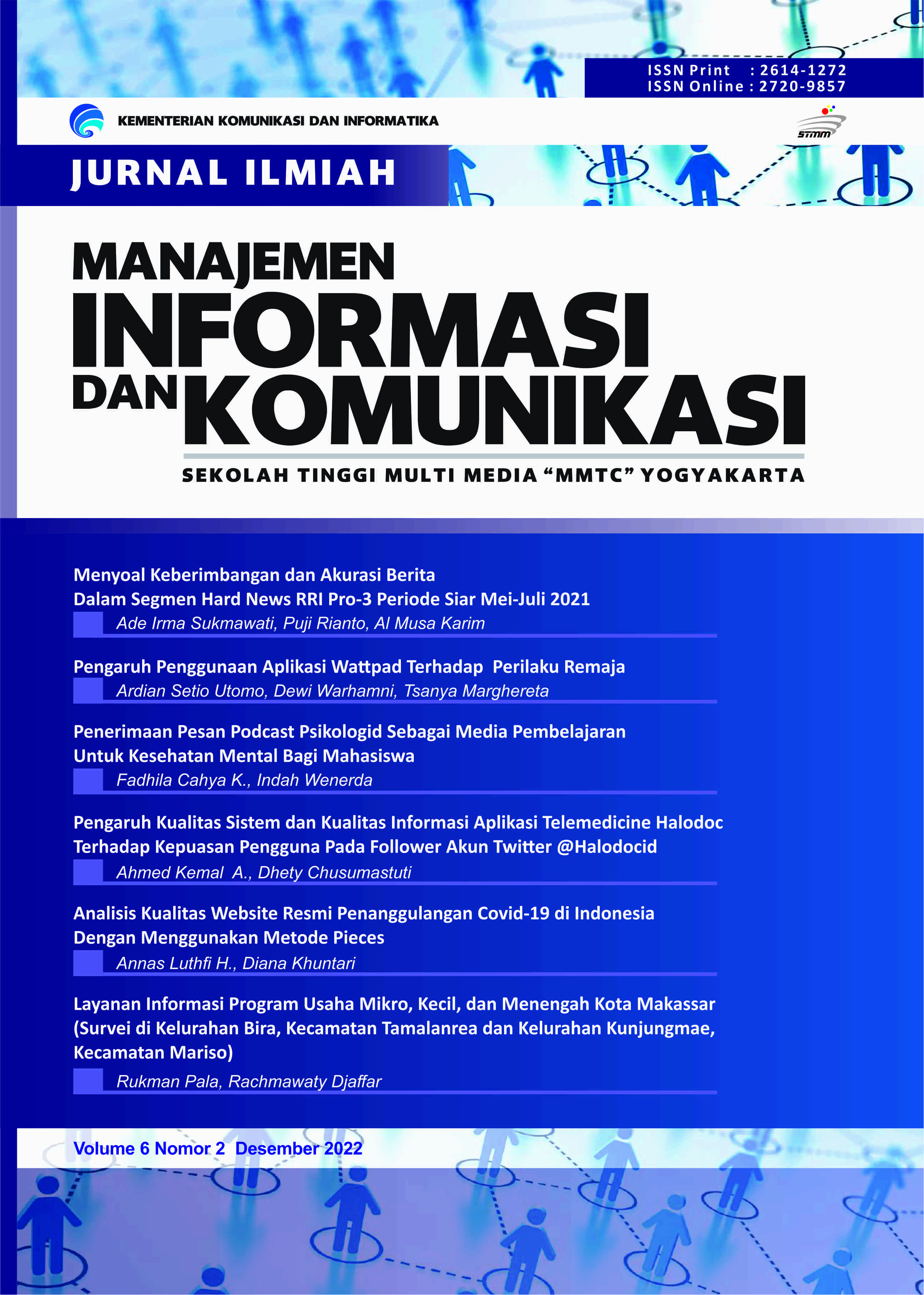
Pengaruh Kualitas Sistem dan Kualitas Informasi Aplikasi Telemedicine Halodoc Terhadap Kepuasan Pengguna Pada Follower Akun Twitter @Halodocid
DOI:
https://doi.org/10.56873/jimik.v6i2.210Kata Kunci:
Telemedicine Application, Halodoc, User Satisfaction, Information Quality, System Quality, Information SystemAbstrak
User satisfaction continues to be a top priority in terms of digital services and is a very important factor for the success of the services. Halodoc is a telemedicine with a mobile application platform whose users are increasing due to the need for information during the Covid-19 pandemic. Halodoc as a health application that has a function as a health information and consulting service in Indonesia is expected to provide good service to provide user satisfaction.In that regards, this study aims to examine the effect of system quality and information quality of Halodoc application on user satisfaction. This research was conducted based on the Information Systems Success model designed by DeLone and McLean by taking several dimensions of success or the required variables.The samples used in this study were followers of the Twitter account @HalodocID who used the Halodoc application as of 10 August 2021. Questionnaires were distributed on 19-30 August 2021.This study chose the multiple linear regression model as a data analysis method that passed five tests; those are the normality test, the linearity test, the multicollinearity test, the autocorrelation test, and the heteroscedasticity test.Prior to the five tests, all questionnaire data from respondents had been tested and declared valid and reliable.Hypothesis testing in this study was carried out by examining the effect of system quality and information quality variables on user satisfaction through simultaneous testing (F test) and partial testing (t test). The research result proves that system quality and information quality have a positive and significant effect on user satisfaction.
Unduhan
Referensi
Amarin, S., & Wijaksana, T. I. (2021). Pengaruh Kualitas Sistem, Kualitas Informasi, dan Kualitas Layanan Terhadap Kepuasan Konsumen (Studi Pada Pengguna Aplikasi Berrybenka di Kota Bandung). Business Management Analysis Journal, 4(1), 37–52. https://doi.org/https://doi.org/10.24176/bmaj.v4i1.6001
American Academy of Family Physicians. (2021). Telehealth and Telemedicine. https://www.aafp.org/about/policies/all/telehealth-telemedicine.html (diakses pada tanggal 11 September 2021).
Azzahrah, F., & Amelia, L. (2021). Analisis Pengaruh Kualitas Pelayanan Aplikasi Maxim Mobile Terhadap Kepuasan Pengguna Dengan Metode Servqual. Jurnal Teknologi Sistem Informasi, 02(01), 59–68. https://doi.org/https://doi.org/10.35957/jtsi.v2i1.849
Burgess, Stephen et al. (2009). Effective Web Presence Solutions for Small Business: Strategies for Successful Implementation. New York: Information Science Reference.
Chin, W. W. & P. A. Todd, (1995), “On the Use, Usefulness, and Ease of Use of Structural Equation Modeling in MIS Research: A Note of Cautionâ€, MIS Quarterly, 19: 237-246.
Davis, F. D. (1989). Perceived Usefulness, Perceived Ease of Use, and User Acceptance of Information Technology. MIS Quarterly, 13(3), 319–340. https://doi.org/10.2307/249008
DeLone, W.H. & McLean, E.R. (1992). Information Systems Success: The Quest for the Dependent Variable. Information System Research, 3(1), 60-95.
DeLone, W.H. & McLean, E.R (2003) Model Of Information Systems Success: A TenYear Update. Journal Of Management Information Systems, 19, 10-15
Fauzi, L.C. (2019). Analisis Pengaruh Sertifikasi ISO Sebagi Sistem Manajemen Mutu Terhadap Kinerja Perusahaan. Jurnal Farmaka. Vol 17 (1)
Halodoc. Frequently Asked Question. https://www.halodoc.com/faq (diakses tanggal 29 Maret 2021)
Huda, B., & Priyatna, B. (2019). Pengguna Aplikasi Content Manajement System (CMS) Untuk Pengembangan Bisnis Berbasis E-Commerce. Systematics. Vol 1, No. 2.
ISO 9241-11. (2018). Ergonomics of Human System Interaction – Part 11: Usability: Definitions and concepts (ISO 9241-11:2018). Switzerland: ISO office. https://www.iso.org/obp/ui/#iso:std:iso:9241:-110:ed-2:v1:en. (diakses pada tanggal 10 April 2021)
Katadata. (2020). Indonesia Peringkat ke-3 Global Memanfaatkan Aplikasi Kesehatan.https://databoks.katadata.co.id/datapublish/2020/10/13/indonesia-peringkat-ke-3-global-memanfaatkan-aplikasi-kesehatan (diakses pada tanggal 8 April 2021).
O’Reilly, T., & Milstein, S. (2011). The Twitter Book, second edition. California: O’Reilly Media. Inc.
Peraturan Perundang-undangan Pasal 4 Undang-Undang Nomor 11 Tahun 2008 tentang Informasi dan Transaksi Elektronik.
Peraturan Perundang-undangan Pasal 42 Undang-Undang Nomor 36 tahun 2009 tentang Kesehatan.
Prasetiyo, D., & Lubis, E. E. (2019). Pengaruh Kualitas Layanan Elektronik Aplikasi Mobile Alodokter Terhadap Kepuasan Pengguna Pada Mahasiswa Fakultas Kedokteran Universitas Riauo Title. Jurnal Online Mahasiswa Fakultas Ilmu Sosial Dan Ilmu Politik, 06(II), 1–15.
Prasojo, L.H. & Pratomo, D. (2015). Pengaruh Kualitas Informasi, Kualitas Sistem dan Kualitas Layanan Aplikasi Rail Ticket System (RTS) Terdahap Kepuasan Pengguna Sistem.
Siagian, Sondang, P. (2018). Manajemen Strategik. Jakarta: Bumi Aksara.
Sugiyono, & Lestari, P. (2021). Metode Penelitian Komunikasi (Kuantitatif, Kualitatif, dan Cara Mudah Menulis Artikel pada Jurnal Internasional). Bandung: Penerbit Alfabeta.
Arikunto, Suharsimi. (2016). Manajemen Penelitian. Jakarta: Rineka Cipta.
Tjiptono, Fandy. (2018). Pemasaran Jasa. Yogyakarta: Penerbit Andi.
Widodo, A, Putranti, H.R.D & Nurchayati. (2016). Pengaruh Kualitas Sistem Aplikasi dan Kualitas Informasi Terhadap Kepuasan Pengguna Sistem Aplikasi RTS (Rail Ticketing System) Dengan Kepercayaan Sebagai Variabel Mediasi, Studi Pada Penumpang “KAI†Ekonomi Operasi 4 Semarang. Jurnal Media Ekonomi dan Manajemen, Vol. 31 No. 2 (Juli), 164.
World Health Organization. (2018). Telemedicine: Opportunities and developments in Member States, Global Observatory for eHealth Series.
Unduhan
File Tambahan
Diterbitkan
Terbitan
Bagian
Lisensi
Penulis yang diterbitkan dengan jurnal ini menyetujui ketentuan berikut:
- Penulis  mempertahankan hak cipta dan memberikan jurnal hak publikasi pertama dengan karya yang secara bersamaan dilisensikan di bawah Lisensi Atribusi Creative Commons  yang memungkinkan orang lain untuk berbagi karya dengan pengakuan atas kepenulisan karya dan publikasi awal dalam jurnal ini.
- Penulis  dapat masuk ke dalam pengaturan kontrak tambahan yang terpisah untuk distribusi non-eksklusif dari versi terbitan jurnal dari karya tersebut ( misalnya  , pengirimannya ke repositori institusional atau menerbitkannya dalam sebuah buku), dengan pengakuan atas publikasi awalnya di jurnal ini.
- Penulis  diizinkan dan didorong untuk memposting karya mereka secara online (misalnya, di repositori institusional atau di situs web mereka) sebelum dan selama proses pengiriman, karena dapat mengarahkan pada pertukaran yang produktif, serta kutipan yang lebih awal dan lebih besar dari karya yang diterbitkan.Â
- Artikel dan semua materi terkait yang diterbitkan di bawah Lisensi Internasional Creative Commons Attribution-ShareAlike 4.0  .