
About the Journal

Focus and Scope

Jurnal Ilmiah Multimedia dan Komunikasi  (JIMK) focuses on the field of multimedia and communication, such as but not limited to research and creation in the fields of:

1. Multimedia and Broadcasting

Graphic design, motion graphics, animation, games, convergence media development, information system design and development (web/mobile), interactive media, film and radio/TV program production, directing, artistic design, lighting design, audio design, camera design, audio video editing, broadcast distribution technology, digital broadcasting, audio video technology, and broadcasting technology.

2. Communication

Mass communication, digital media/new media, visual communication, public relations, media industry, advertising, journalism, and marketing communication.

Peer Review Process

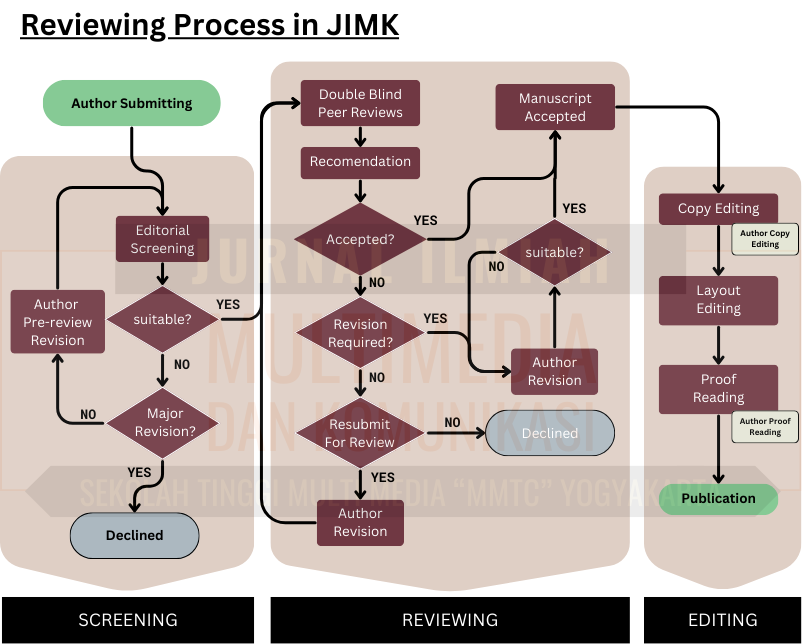
  1. The publisher accepts articles that have not been published in other media. Every article submitted to the journal editorial board will be checked first (Screening Stage) to determine the suitability of the article topic with the focus and scope of the journal. In addition, the article will also be evaluated for similarity to determine the level of plagiarism. If the article is in accordance with the focus and scope of the journal and the plagiarism level is less than 25%, it can proceed to the next stage.
  2. Every article that passes screening continues to the Reviewing Stage.
    1. Articles will be reviewed by at least 2 reviewers (Peer Reviewers) with a double-blind peer review process (as much as possible, efforts are made to ensure that peer reviewers do not know the identity of the author of the article being reviewed, and vice versa). 
    2. Articles that have been reviewed are decided to be accepted, revised, revised for re-review, or rejected based on the recommendations of the Peer Reviewers.
  3. If the final decision is that the article is accepted, the article enters the Editing Stage. At this stage, copy editing, layout editing, and publication are carried out.

Reviewing process in JIMK journal is shown in the figure below :
Publication Frequency

JIMK publishes issues twice in a year, that is in :

  • June and
  • December.

Open Access Policy

Jurnal Ilmiah Multimedia dan Komunikasi (JIMK)  provides open access which means all content is freely available at no cost to users or institutions. Users are allowed to read, download, copy, distribute, print, search, or link to full-text articles in this journal without asking prior permission from the publisher or author, following the creative commons license. If users use content in this journal for research material or article writing, users are required to cite the name of the article author in the created item.

Plagiarism Screening

  1. Every article submitted will have its plagiarism level evaluated using Dupcheck (Turnitin) or other similarity checkers.
  2. If the plagiarism level of an article is found to exceed 25%, the article will be rejected or returned to the author for revision and resubmission to JIMK.

Author Fees

Publishing article in Jurnal Ilmiah Multimedia dan Komunikasi is free of charge

Publication Ethics and Malpractice Statement

Referring to the Regulation of the Head of the Indonesian Institute of Sciences Number 5 of 2014 concerning the Code of Ethics for Scientific Publications,

  1. Scientific publication is the result of the thought of a person or group of people, after going through scientific review, disseminated in the form of scientific written works, including: journals, books, proceedings, research reports, papers, and scientific posters.
  2. Researcher Code of Ethics is a moral reference that applies nationally to researchers in research and development (R&D) units in conducting research and publishing research results for the development of science and technology for humanity.
  3. Scientific Journal Manager is an institution that publishes scientific manuscripts that have met scientific and ethical standards, Intellectual Property Rights, and promotes and ensures the sustainability of journal publishing.
  4. Scientific Journal Editor is a person who coordinates the roles and functions of authors, peer reviewers, and journal managers in the process of publishing written works based on scientific and ethical standards.
  5. Scientific Journal Peer Reviewer is a person who assists the editor in critically reviewing the substance of scientific written works in accordance with their field of expertise.
  6. Scientific Journal Author is a person who expresses the results of their thoughts and/or research and development in the form of written works that have met the requirements of scientific and ethical standards.
  7. The Code of Ethics for Scientific Publications aims to assist Scientific Journal Managers in:
    1. improving the quality of scientific journals in accordance with international scientific journal quality standards; and
    2. assisting Scientific Journal Managers in applying publication ethical values, namely: neutrality, fairness, and honesty.
  8. The Code of Ethics for Scientific Publications applies to Scientific Journal Managers and serves as a reference for controlling the management of scientific journals in the implementation of Scientific Publication activities.
  9. Scientific Publication Ethics relates to the performance and work of scientific research that is in accordance with ethical standards in research and science.
  10. The essence of Scientific Publication Ethics upholds three ethical values in publication, namely:
    • Neutrality, which is free from conflicts of interest in publication management;
    • Fairness, which is granting authorship rights to those who are rightfully the authors; and
    • Honesty, which is free from duplication, fabrication, and plagiarism (DF&P) in publication.
  11. By adhering to these three ethical values, this Code of Ethics for Scientific Publications guides managers, editors, peer reviewers, authors, and sponsors/third parties in the scientific journal publication system to always comply with the code of ethics, follow standards, and accept responsibility for good scientific publication management practices as outlined in the following four groups.
    • First, practices related to the duties of scientific journal managers, namely formulating publication policies and programs, facilitating the work of editors and peer reviewers, respecting the decisions of editors and peer reviewers, and determining sponsors and third parties. In publishing practices, managers are obligated to ensure publications that fully comply with the Code of Ethics for Scientific Publications. Regarding practices related to the role of sponsors, it is emphasized that sponsors and third parties should not request any compensation and should not influence the policies and programs of the journal manager.
    • Second, practices in the duties of editors, namely making publication decisions for written works, managing the review of written works, and ensuring the fairness of the review results, confidentiality of the content of written works, and the integrity and prevention of misuse of written works.
    • Third, practices in the duties of peer reviewers, namely conducting reviews either in a closed or open manner, checking the accuracy and correctness of data sources and references, the appropriateness of concepts, and the objectivity of the content of written works, as well as conducting reviews with neutrality.
    • Fourth, editors examine practices related to the duties of authors, namely authorship standards of written works, statements of originality of the content of written works, detection of possible duplication of written works, completeness of acknowledgment of contributions, authorship statements, and statements of funding sources.
  12. Contents and all statements in the article in this journal is in author responsibility.

Journal History

Jurnal Ilmiah Multimedia dan Komunikasi (JIMK) was initially published offline in 2016 with the aim of providing the academic community from within and outside the Sekolah Tinggi Multi Media (STMM) with a platform to publish research results in the fields of multimedia and communication. Starting in 2021, JIMK has been published online twice a year, in June and December. As of 2024, 9 volumes of the journal have been published; more details can be found on the Archive JIMK page.

From the initial publication of JIMK until Vol 9 No 2 December 2024, a 2-column layout was used. After considering various inputs and the ease of writing and layout processes, it was decided that starting from Vol 10 No 1 June 2025, a 1-column layout would be adopted.

OJS version 2 was chosen as the journal management system when JIMK was first published online. In October 2025, the OJS system was upgraded to version 3.0. Additionally, it was decided that starting from December 2025 and onwards, English would be used for publication.