
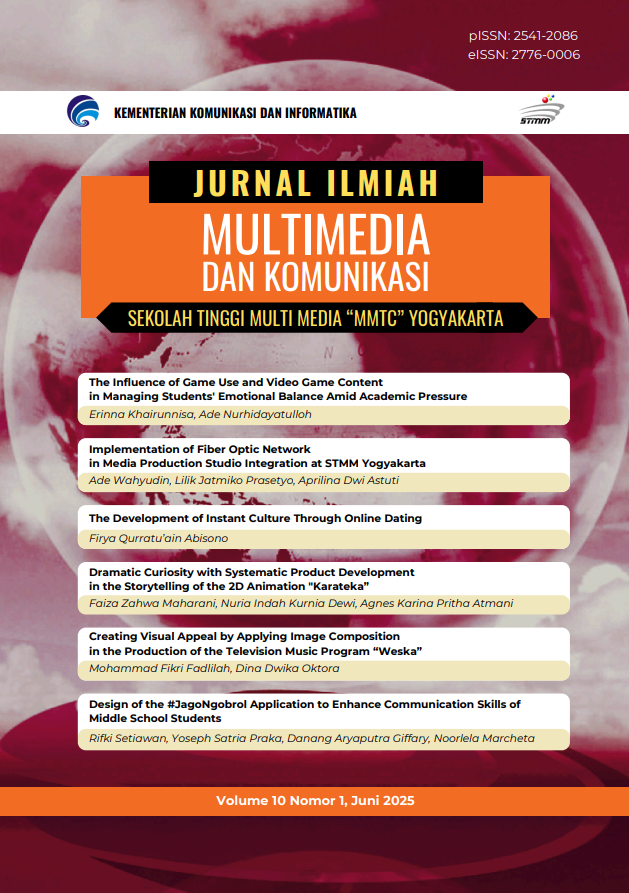
Dramatic Curiosity with Systematic Product Development in the Storytelling of the 2D Animation "Karatekaâ€
DOI:
https://doi.org/10.56873/jimk.v10i1.435Keywords:
Dramatic Curiosity, Storytelling, Performance Anxiety, ADDIEAbstract
Performance anxiety is a common type of anxiety experienced by athletes in the realm of sports, even among those in excellent physical condition. This anxiety significantly impacts athletes' mental and psychological performance, which serves as the inspiration for creating a 2D animated film titled Karateka. The film addresses the theme of performance anxiety among athletes. Additionally, animated films that explore anxiety within the context of sports are relatively limited in number. The first step in creating the Karateka 2D animated film was determining the core idea based on the issue to be discussed. This idea was then developed into a script through the process of structuring the storyline. As a result, a compelling narrative and plot were crafted to captivate the audience’s interest in this 2D animated film. To further engage viewers, the creator incorporated elements of dramatic curiosity into the film. In developing the script for Karateka, the ADDIE method (Analysis, Design, Development, Implementation, and Evaluation) was employed. During the analysis stage, the creator conducted a literature review and observational studies. In the design phase, dramatic curiosity was distributed throughout the storyline using a dramatic graph. The development stage involved refining the plot and story outline, while the implementation phase focused on creating script segments infused with elements of dramatic curiosity. Finally, during the evaluation stage, the creator conducted focus group discussions and expert validation tests to assess the application of curiosity elements in the developed segmentsDownloads
References
Amir, N. (2012). Pengembangan alat ukur kecemasan olahraga. Jurnal Penelitian dan evaluasi pendidikan, 16(1), 325-347. https://journal.uny.ac.id/index.php/jpep/article/view/1120
Arifin, M. (2022). Penggunaan Curiosity untuk Menunjukkan Perkembangan Tokoh Utama dalam Skenario Film Fiksi “Tanda Merah†(Doctoral dissertation, ISI Yogyakarta). http://digilib.isi.ac.id/id/eprint/10964
Biran, M. Y., & Misbach, H. (2006). Teknik Menulis Skenario Film Cerita. Pustaka Jaya.
Branch, R. M. (2009). Instructional design: The ADDIE approach (Vol. 722). New York: Springer.
Clements, R., & Musker, J. (Directors). (2016). Moana [Film]. Walt Disney Animation Studios.
Dewi, E. M. P. (2018). Psikologi Olahraga Mental Training
Field, S. (2005). Screenplay: The foundations of screenwriting. Delta.
Hindiari, Y., & Wismanadi, H. (2022). Tingkat kecemasan atlet karate menjelang pertandingan pada anggota Cakra Koarmatim. Jurnal Kesehatan Olahraga, 10(01), 179-186. https://ejournal.unesa.ac.id/index.php/jurnal-kesehatan-olahraga/article/view/44094
Howard, B., & Moore, R. (Directors). (2016). Zootopia [Film]. Walt Disney Animation Studios.
Kasilo, D. (2008). Komunikasi cinta: Menembus g-spot konsumen Indonesia. Kepustakaan Populer Gramedia.
Kurniawan, A. W., Wijayanto, A., Amiq, F., & Hafiz, M. (2021). Psikologi olahraga. Malang: Akademia Pustaka.
Lutters, E. (2005). Kunci sukses: menulis skenario. Grasindo.
Miftah, F. (2024). Penerapan Penceritaan Terbatas dalam Skenario Film" Panglong" untuk Membangun Unsur Dramatik Curiosity (Doctoral dissertation, Institut Seni Indonesia Yogyakarta). http://digilib.isi.ac.id/id/eprint/17107
Pratista, H. (2017). Memahami Film-Edisi 2. Montase Press.
Shuhaib, M. (2024). Foreshadowing Overuse: A Stylistic Approach to Modernist Fictional Writing. Al-Adab Journal, (149), 1-18.
Unkrich, L. (Director). (2017). Coco [Film]. Pixar Animation Studios.
Downloads
Additional Files
Published
Issue
Section
License
Authors who publish articles in this journal agree to the following terms:
- Copyright remains with the authors and grants the Journal of Communication and Multimedia Science the authority to publish the article under the Creative Commons Attribution 4.0 International License, which allows the article to be shared with acknowledgment of the article's authors and this journal as the place of publication.
- Authors may distribute their article publication non-exclusively (for example: in a university repository or book) with notice or acknowledgment of publication in Option journal.
- Authors are permitted to post their work online (for example: on a personal website or in a university repository) before and after the submission process (see The Impact of Open Access)